The Hidden-Symbol Trap: When Details Are Just Details
The hidden-symbol trap turns repeated objects into secret messages. Learn to weigh visual evidence, context, and uncertainty before settling on a reading.
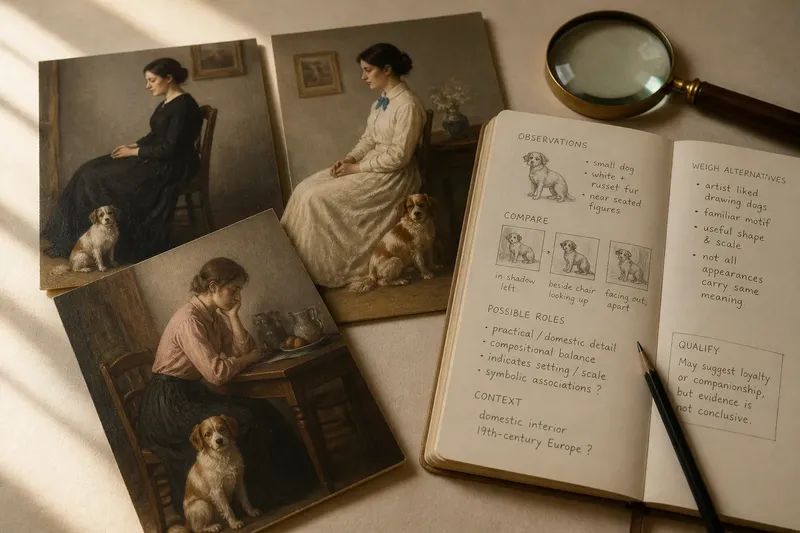
You spot the same small dog in several paintings by one artist and wonder what it means. The hidden-symbol trap begins when repetition itself becomes the answer: the dog must stand for loyalty, grief, or some private code. Repetition is worth noticing, but it is not yet an interpretation.
A more useful question is what kind of evidence you have. An object can carry symbolic weight, serve a practical role, help organize a picture, or simply recur because an artist liked drawing it. Those possibilities are not equally likely in every case. The task is to choose a reading that fits the visible evidence without asking the object to tell a story it cannot support.
What kind of detail are you looking at?
Start by separating what you can see from what you infer. “A dog appears beside the seated figure” is an observation. “The dog represents fidelity” is a claim about meaning. Keeping the two apart is like labeling the ingredients before deciding what a stew tastes like; it prevents a hunch from quietly becoming a fact.
Then consider the object’s job in the image. A cup may establish a domestic setting, give a hand somewhere to rest, balance a bright patch of color, or invite associations with hospitality. Several of these can be true at once. A detail need not be either purely decorative or deeply symbolic.
Ask whether the proposed meaning explains something specific: why the object appears in this position, why it is emphasized, or why it changes across related works. If the reading would remain just as convincing after swapping the dog for a vase, it may be too general to explain the picture.
When does repetition deserve attention?
Recurring details can matter, but frequency alone is weak evidence. An artist may repeat a motif because it belongs to a familiar setting, suits a preferred format, or offers a useful shape. A motif’s meaning becomes more plausible when its placement, treatment, or relation to other elements also changes in a consistent, interpretable way.
Compare the detail across images without assuming that each appearance means the same thing. Note its scale, color, condition, and position. Is it conspicuous or partly hidden? Does a figure engage with it, ignore it, or seem separated from it? Does it appear in a cluster of related objects, or alone? These observations may narrow the possibilities, though they do not supply a private dictionary.
Context matters too. A key in a still life of domestic objects may be an ordinary possession; in a portrait, it might help identify a role or point toward access and authority. Neither reading follows automatically from the object’s name. The surrounding scene does the interpretive work.
Which situation describes your reading?
Do you have only one image in front of you?
Keep the interpretation close to what the image shows. Describe the object’s position, visual emphasis, and relationship to nearby figures before proposing a meaning. A single appearance rarely supports a firm claim about an artist’s recurring private symbolism.
Does the same object recur across several works?
Treat recurrence as a reason to compare, not as proof of a code. Look for meaningful changes in setting and use, and consider whether the artist repeatedly drew familiar subjects for practical or stylistic reasons. If the appearances vary widely, a single fixed meaning may explain less than it seems to.
Does a reading depend on historical or cultural context?
Check whether the proposed association fits the particular place, period, and social setting of the work. A symbol can have several meanings, and a contemporary association may not match an earlier one. If reliable context is unavailable, describe the possibility as uncertain rather than presenting it as settled.
Are you relying on a story you heard about the artist?
Separate the story from the visible case. Biographical details can inform interpretation, but they do not make every object a coded confession. Ask whether the image supports the reading on its own, and whether the story is documented or merely repeated.
When should you stop short of a symbolic claim?
Stop short when the proposed meaning rests on a single association you brought to the image, when the object is not visually emphasized, or when the reading requires several unsupported assumptions. A modest description is not a failed interpretation. “The bird draws attention to the window” may be more accurate than “the bird represents the soul,” especially if the picture offers no further clue.
Also pause when a claim depends on a universal symbol list. A rose, mirror, candle, or skull can acquire different meanings through context, and can also serve as an ordinary object or compositional feature. A familiar association is a starting point for looking, not permission to stop looking.
Imagine you are viewing a portrait with a small orange on the table. You notice another orange in a second portrait and suspect a shared message. Compare the fruit’s placement and condition: if one sits among other foods and the other acts as a bright counterweight near the sitter’s sleeve, the recurrence may reflect a preferred subject or color accent rather than one stable code. You can still note that the fruit may invite associations with abundance, but the pictures do not yet settle that question.
How can you make a reading more precise?
Use language that shows how strong your evidence is. “The object functions as a symbol of mourning” makes a firm claim. “The object may suggest mourning, given its contrast with the surrounding scene” identifies a possibility and names the reason for it. That small distinction helps a reader see where observation ends and interpretation begins.
A compact process can keep the reading grounded:
- Describe: Name the object and state where it appears without assigning meaning.
- Notice emphasis: Ask whether contrast, scale, light, or placement makes it prominent.
- Compare: Look at other appearances and record what changes as well as what repeats.
- Test context: Consider the scene and relevant cultural setting, without importing a universal code.
- Weigh alternatives: Ask whether practical, decorative, or compositional roles explain the same evidence.
- Qualify the claim: State what seems plausible and what remains unknown.
For example, if a mirror appears beside a figure, it may support a reading about self-scrutiny if the figure engages with it and the composition makes that relationship salient. If it sits among unrelated household furnishings, a simpler account may fit better. The point is not to ban symbolic readings, but to make them answer to the image.
What is the most defensible reading?
Choose the interpretation that accounts for the most visible details while making the fewest unsupported leaps. Sometimes that will be a symbolic reading. Sometimes the object is mainly useful, decorative, or formally convenient. Sometimes the picture leaves the question open, which is not an invitation to fill the silence with certainty.
The hidden-symbol trap is especially tempting because a secret message makes a detail feel important. But importance can come from how an object shapes attention, establishes a setting, or links parts of a composition. When you return to the image, ask what the detail actually does before deciding what it secretly says. That distinction is the heart of a careful reading.