Before the Easel: Where Artists Made Their Work
Where artists made their work shaped the tools, scale, and stages available to them; learn to read those clues without inventing a studio story.
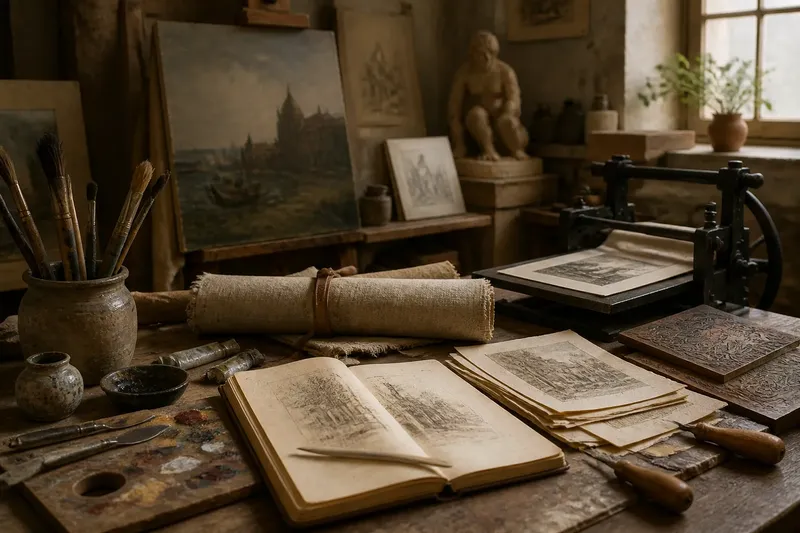
Where artists made their work is a useful question when a picture seems unusually intimate, very large, or built from materials that do not quite fit its image. A painter working in a room, a printmaker at a press, and a traveling artist carrying a sketchbook faced different practical limits. Those limits did not dictate the art, but they helped set its working terms.
When a work’s setting of production is unclear, viewers often reach for a familiar picture: a solitary artist before an easel. Easel painting is one visible arrangement, not a universal account of artistic labor. Art was also made in workshops, court rooms, rented chambers, religious spaces, streets, gardens, ships, and shared homes. Looking for the conditions of work can make an object’s size, surface, and signs of revision easier to read without turning every mark into a clue about the artist’s personality.
What can a working place explain?
A place of making is not simply a backdrop. It determines what can be carried, stored, spread out, or left unfinished. A permanent room can hold large supports and prepared materials. A temporary workplace favors portable tools and work that can be packed away. A busy workshop allows several hands and stages of production to occupy the same space.
These differences can be visible in the finished object. A work assembled from portable sheets may have joins or changes in support. A large painting may show a scale of preparation that would be awkward in a narrow room. A print might belong to a process involving a press, plates, inks, and repeated handling rather than to a single act at an easel.
The safest inference is modest: the object suggests conditions that may have suited its production. It does not, by itself, reveal the exact room, daily routine, or people present. An image of a studio is evidence of how a studio was represented, not necessarily a reliable floor plan.
Why does the easel studio seem like the default?
The easel studio is a familiar image of artistic work: a painter, a canvas, a chair, and a concentrated gaze. Its prominence in popular images of art-making reflects a narrow view of the work, especially painting, rather than a complete history of where art was produced. The easel also belongs chiefly to certain formats and media. It is no useful model for a sculptor shaping clay, a textile worker at a loom, or a printmaker preparing a plate.
Workshops often organized production around shared equipment and specialized tasks. Assistants could prepare supports, mix materials, transfer designs, or complete portions of an object under direction. The workshop was not merely a larger private studio; it had its own division of labor and rhythms. A polished surface might reflect careful preparation across several stages rather than a solitary burst of inspiration.
Other artists worked where the subject or commission required them to be. A portrait session, a building project, or a view drawn outdoors could make location part of the process. The artist might carry a small set of materials, make preliminary studies on site, and complete a larger work elsewhere. “Made there” and “finished there” are not always the same claim.
What clues help identify a working setting?
Begin with the object’s practical demands. Consider its size, support, surface, and apparent method of production. Then ask what equipment those demands imply. A canvas could be stretched and worked in a room with space to move around it; a carved object required tools and a stable surface; a printed image involved a sequence of preparation and transfer. These are questions about material conditions, not secret symbols.
- Scale: Check whether the work appears readily portable. If it is small and light, then a temporary or outdoor setting remains plausible; if it is large, then consider a fixed workspace or staged assembly instead of assuming a spacious studio.
- Support: Check whether the work is on paper, panel, canvas, cloth, clay, or another material. If its support is easy to carry, then travel is plausible; if it is rigid or cumbersome, then consider a stable work area or help moving it.
- Surface: Check for joins, seams, edges, or layered passages. If these mark distinct stages, then consider staged production; if no such features are visible, then do not infer that the work was made in one sitting.
- Repeated forms: Check whether similar images or components recur. If they do, then consider a process designed for multiples or coordinated workshop labor; if they do not, then leave open other production methods.
- Depicted surroundings: Check whether the setting is central to the image or simply a conventional scene of artistic labor. If it is depicted, then treat it as part of the subject unless independent evidence connects it to the artist’s actual workplace.
- Portability: Check whether the apparent tools and materials suit travel, outdoor work, or equipment left in place. If portability seems likely, then consider a temporary station; if the process requires fixed equipment, then consider a workshop or other stable setting.
Each clue narrows possibilities rather than settling them. A small painting may have been made in a large studio, and a large work could have been planned through smaller studies. Objects can travel between locations, too. A support begun in one place may be altered or finished in another.
How did different settings shape the work?
In a workshop, shared tools could support repeated production and work at substantial scale. The cost was coordination: materials, tasks, and hands had to meet in a useful order. A workshop’s visual character may therefore involve consistency as well as variation. Similar motifs do not automatically mean the same person made every part.
In a private room, an artist could keep materials near at hand and return to a work over time. The room’s dimensions still mattered. A narrow passage might limit how far the artist could step back; stored objects could occupy floor space; drying work needed somewhere to remain undisturbed. Such constraints could encourage smaller formats or a more compact arrangement, though they would not dictate either choice.
Outdoor work made light, weather, and the need to carry supplies immediate concerns. A portable sketchbook or prepared board could suit a short session; a more elaborate work might require a return indoors for continued work. The setting could shape what was observed: a changing view might prompt decisions about what to record, what to omit, and which moment to treat as the subject.
Say an artist has a sketchbook, a pencil, and a prepared board, and must work between a shared kitchen table and a nearby street. The artist first uses the pencil and sketchbook outdoors to note a building and its changing shadow, then carries the notes home, clears the table, and develops a drawing on the board. The likely result is a compact record of observation paired with a more deliberate indoor composition; the tradeoff is that the finished drawing reflects the notes rather than every change in the street. This invented situation shows how a place can divide observation from finishing without making either stage less authentic.
What should you ask when the setting is uncertain?
Can a picture of a studio prove where the artist worked?
No. It may record a real workplace, a conventional image of artistic activity, or a mixture of both. Treat visible furnishings as part of the picture’s subject unless other evidence supports a claim about the actual workroom.
Does a large work mean it was made in a large studio?
Not necessarily. A large object may have been assembled from sections, prepared in stages, or worked on in a space suited to only part of the process. Its dimensions suggest practical questions, not a complete account of its origin.
Can a work’s surface reveal who made each part?
Surface differences can suggest changes in handling or stages of work, but they do not reliably identify individual hands on their own. Workshop production and later alteration both complicate that judgment.
How can a viewer avoid inventing an artist’s routine?
Separate what the object visibly shows from what you infer about its production. Use cautious language such as “may suggest” when the evidence is indirect, and leave the room’s exact arrangement unknown when the work cannot establish it.
How can place change the way you look?
Move from broad questions to visible details. First identify what the work is made on and how large it is. Next, consider what kind of handling that support permits. Then compare those demands with a few plausible settings: a fixed workshop, private room, shared interior, or temporary outdoor station. This is not a formula for assigning an origin; it is a way to notice what the object asks of a working space.
Think of the setting as a workbench rather than a stage set. A workbench leaves traces of what can be reached, held, or kept nearby, but it does not explain the whole project. The analogy is useful precisely because it is limited: an artwork is not just the output of its tools, and artists can adapt to awkward conditions or choose them for a reason.
When the evidence supports several possibilities, keep them open. A broad claim about a work’s practical demands is often stronger than a confident story about one artist’s habits. Where artists made their work becomes informative when it helps explain why a material, scale, or sequence of marks makes sense—not when it supplies an imagined biography.
For a closer reading, return to the object after considering its likely working place. Notice whether its edges, joins, repeated forms, or degree of finish now seem more legible. The question is not which single studio scene must be true, but how the means of making entered the form that remains.